Word Box - Sort & Block Jam
- 4.8
- Rating
- 100.00K
- Installs
- Free
- Price
 Analysis by App-foxy
I went into Word Box - Sort & Block Jam expecting a quick word game and found something better described as a compact puzzle habit. It sits in the word category, but the “box” and “block” idea gives it a more spatial feel than a traditional crossword or an ordinary anagram app. You are not simply searching for vocabulary in a list; you are working through a visual arrangement where the order of your choices matters.
That distinction is important. If you enjoy wordplay but lose interest when a game becomes repetitive, the sorting element gives each short session a little more to think about. If you prefer calm, predictable crossword solving, the block-jam format may feel less familiar at first. After spending time with it, my impression is that this is best treated as a flexible pick-up-and-play game rather than a deep replacement for a full daily puzzle routine.
How the current version feels to play
The current release is version 1.2.1.0, and the game is free to install on Android devices running version 8.0 or later. Yalla Technology FZ-LLC is the developer, and the app has built a visible audience with over 50 thousand installs. Its average score is 4.8 from around 464 ratings, which suggests that the basic idea is connecting well with the people who have tried it, although a rating alone cannot tell you whether its particular style suits you.
You May Also Like

 Blood Strike: 2.5 Anniversary
Blood Strike’s Loadouts Turn Every Drop Into a Tactical Gamble
A close look at Blood Strike’s custom loadouts: how fast access to signature weapons reshapes its battle royale rhythm, rewards preparation, and narrows the gap between fights.

 Pandora - Music & Podcasts
Pandora’s Music Is Easy to Start, but Harder to Recover
Pandora’s strength is its low-effort path from a seed to a station. Its weak spot is how much confidence it asks you to place in connection, setup, and quiet recovery.

 8 Ball Pool
 Is Built on Rivalries, Rematches, and Routine
A close look at the rivalries, rematches, shared routines, and unanswered safety questions that turn a quick pool match into a persistent mobile community.

 Samsung Music
’s Quiet Strength Is Playing What You Already Own
Its reach comes less from spectacle than from dependable access to a personal library. That simplicity is both the app’s strongest retention engine and its ceiling.

 AccuWeather: Weather Radar
AccuWeather Review: A Quick, Clear Forecast for Everyday Decisions
For everyday plans, the best forecast is the one you can understand quickly. AccuWeather makes rain timing, radar, and local conditions easy to act on, with a few trade-offs.

 Hill Climb Racing
Why Hill Climb Racing Still Turns Crashes Into One More Run
A tiny car, a bumpy hill and one more upgrade: Hill Climb Racing keeps resurfacing because its simple chaos makes every near-miss feel personal.
More From Our News Desk



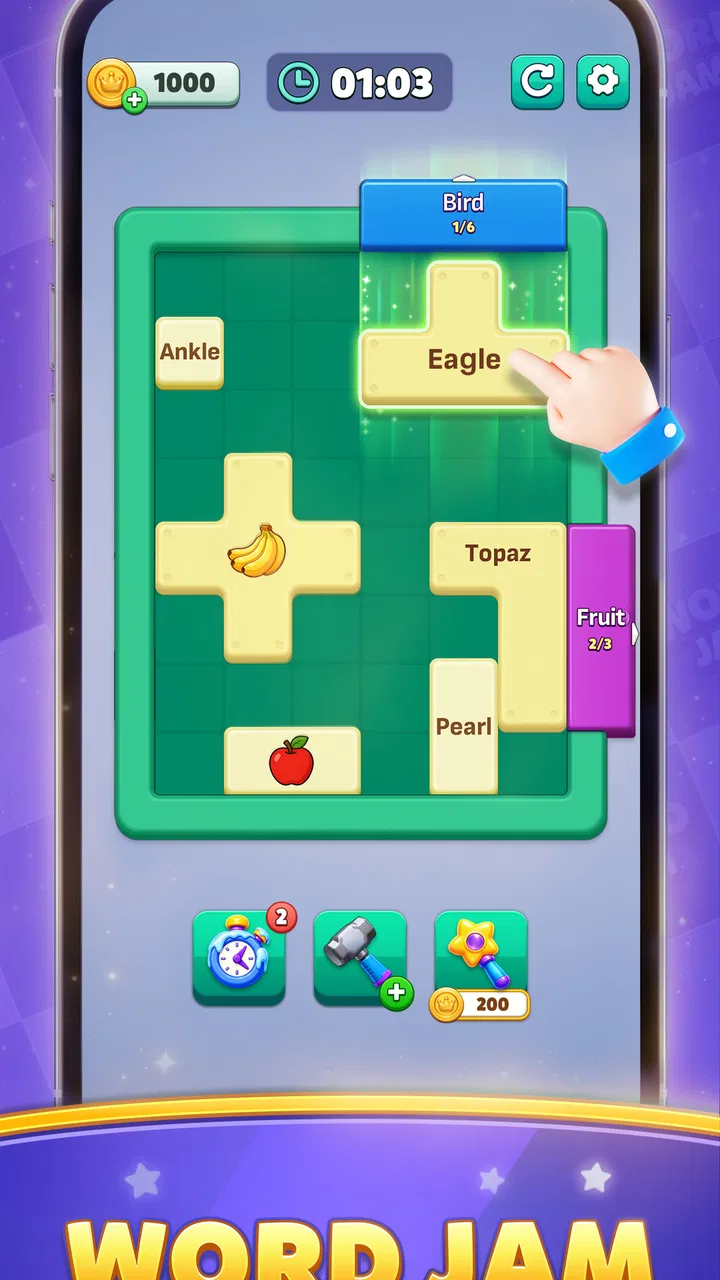
My first useful observation is that the game asks for two kinds of attention at once. I have to recognize possible words, but I also have to read the board as a structure. A word that looks obvious in isolation may not be the best choice if it leaves the remaining blocks awkwardly positioned. That small conflict between vocabulary and placement is where the game earns its name and where much of its appeal comes from.
I found the format especially comfortable in short breaks. It works well when I have a few minutes before an appointment or want something more active than scrolling. The individual decisions are small, but they still give me a reason to pause and inspect the layout. That makes it less mindless than many casual matching games without turning every round into a demanding study session.
The word-and-space combination
Many word games reward recognition alone. You see letters, identify a word, and move on. Here, the visual arrangement changes the rhythm. I often catch myself considering whether to use a tempting word immediately or hold back while I inspect what it might expose or obstruct. That is a useful wrinkle for players who like light planning.
The experience is also more approachable than a serious word challenge because the board communicates part of the problem visually. Someone who does not enjoy dense text grids may find the blocks easier to read at a glance. On the other hand, players who want precise definitions, rich vocabulary explanations, or a competitive spelling test may find the presentation too focused on movement and arrangement.
A practical tip is to avoid tapping the first familiar combination you notice. I get better results when I scan the entire box first, identify the most constrained area, and then decide whether a short word or a longer-looking option gives me more room. This is not a dramatic advanced system, but it changes the game from reflexive guessing into a simple planning exercise.
Where it fits in a normal day
My favorite use case is a short evening reset. I can play while waiting for tea to boil, stop after a single puzzle, and return later without needing to remember a complicated story or control scheme. That low commitment is one of its strongest qualities. It does not demand that I reserve a long uninterrupted session just to make progress.
It can also work for families because the content rating is Everyone. That does not mean every child will find the puzzles equally easy, of course. Younger players may need help understanding the word choices or the spatial logic, while adults may appreciate using a round as a relaxed vocabulary warm-up. I would still treat it as a shared puzzle rather than assume it is automatically ideal for every age group.
For commuters or people who regularly play with limited time, the format is more suitable than a long-form word board game. For someone seeking a serious daily challenge with a carefully measured difficulty curve, a dedicated crossword or spelling title may offer more depth and a clearer sense of progression.
What the release details tell me about its direction
The game was released on March 31, 2026, so the current version represents an early stage in its life rather than a mature, long-established puzzle platform. That matters when judging it. I can evaluate the core experience as it stands, but I would not treat the present feature set as a final statement about where the product will go.
The move to version 1.2.1.0 suggests that the app has already progressed beyond its first public build. I would read that as evidence of ongoing refinement, not proof of any particular new feature. The responsible expectation is that future updates may improve the play experience, but players should decide whether the current version is enjoyable now rather than installing solely for promises about later development.
There is a useful difference between product evolution and product identity here. A later update can smooth menus, adjust puzzle presentation, or address friction, but the central question remains whether you like combining word recognition with block arrangement. No update can make that basic style appealing to somebody who only wants classic clue solving. Conversely, players who enjoy the concept may find even small usability improvements meaningful because this is a game built around repeated, quick decisions.
What existing users are likely to notice
Players already using the game will probably judge updates by how quickly they can return to a puzzle and how clearly the board communicates its next move. In a title this compact, minor interruptions matter more than they would in a large adventure game. A confusing transition, an unclear selection state, or a board that is difficult to read can break the concentration that makes the puzzle satisfying.
My advice for returning players is to reassess your habits after updating rather than assuming the same approach will always be optimal. Start by scanning the full layout, then test whether the most restricted block should be handled first. If a round feels stuck, step back and look for a different word grouping instead of repeatedly trying the same obvious move. The game rewards a change in perspective more than frantic tapping.
New users should give themselves several rounds before deciding whether it is for them. The first few puzzles can feel like a simple word exercise, but the spatial element becomes more noticeable once you stop treating every available word as an immediate answer. That learning curve is gentle, yet it is still a curve. The game is more enjoyable when you allow yourself to learn its visual language.
Free access and the purchase question
The game is free, with in-app purchases ranging from $0.99 to $49.99 per item. That makes the initial decision straightforward: you can try the basic experience before spending anything. I appreciate that approach for a casual puzzle because the central question is personal fit, and a short test is more useful than a description.
The wide purchase range also means I would be cautious about buying impulsively. Before paying, I would first establish what is actually slowing me down: the puzzle itself, a lack of time, or a desire to remove an interruption. If I am enjoying the core word-and-block challenge, a small optional purchase may feel reasonable. If I am not enjoying that core loop, spending more will not solve the underlying mismatch.
For parents, the free starting point is useful, but the purchase range is a reason to review device controls and payment habits before handing the phone to a child. The Everyone rating describes the content audience, not a guarantee that every purchase decision will be made thoughtfully. I would set expectations clearly and keep spending under control.
Where the game is strong and where it still falls short
The strongest part is the combination of accessibility and modest planning. I do not need to learn a complicated ruleset, yet I am rarely making choices without considering their consequences. That balance gives the game a pleasant middle ground between a pure vocabulary quiz and a spatial logic puzzle.
It is also easy to recommend to people who want a game that can be paused mentally as well as physically. I can finish a small session without feeling that I have abandoned a long campaign. The format respects short attention windows, which is a genuine advantage over word games that depend on extended concentration or a fixed daily schedule.
The limitation is that this same compactness may reduce its appeal over time for expert word-game players. Anyone who wants extensive clue variety, a large strategic vocabulary, multiplayer competition, or a strong long-term achievement structure may eventually want a more specialized alternative. I would not choose this as my only word game if I were looking for a deep competitive hobby.
Another trade-off is the balance between visual clarity and challenge. A board-based puzzle can be easier to approach than a page full of clues, but it can also make the experience feel less literary. Players who enjoy discovering unusual words and understanding why an answer is correct may prefer a dictionary-led game. This one is more about fitting pieces of language into a changing arrangement.
I also think the game depends heavily on presentation quality. In a word title, the interface is not decoration; it is part of the reasoning. If the blocks, selections, or remaining choices are hard to distinguish, the puzzle becomes frustrating for the wrong reason. That is the area I would watch most closely as the product develops, because a small clarity improvement could make repeated sessions noticeably smoother.
Who should try it, and who should skip it
I would recommend it to casual players who like word games but want something more tactile than a standard anagram list. It is a good match for short sessions, relaxed concentration, and people who enjoy finding a route through a visual problem. It may also suit families looking for a simple puzzle to discuss together, provided adults manage purchases sensibly.
I would skip it if my main goal were a strict spelling workout, advanced crossword clues, or a competitive leaderboard experience. I would also look elsewhere if I disliked games where the order of moves can matter. A conventional word search may feel cleaner for that audience, while a crossword may provide more satisfying depth for players who enjoy clues and language nuance.
One less obvious trade-off is that the game can be useful as a mental transition between tasks, but that does not make it ideal for multitasking. The spatial arrangement deserves enough attention to see the consequences of a move. I can play in a short break, but I do not play well while simultaneously watching a video or carrying on a demanding conversation.
Another useful workflow is to treat each puzzle as a visual sorting task first and a word task second. I look for the area with the fewest plausible options, consider which move preserves the most flexibility, and only then commit. This approach is particularly helpful when the obvious word creates a dead end. It is a small change, but it gives the game more strategic texture than the short summary might suggest.
What I would watch as it continues to grow
Because the game is still relatively new, I would watch how Yalla Technology FZ-LLC handles the balance between quick accessibility and lasting variety. The basic loop is easy to understand, so future value will depend on whether repeated play continues to feel fresh without becoming unnecessarily complicated.
I would also pay attention to how clearly the game communicates mistakes, progress, and available choices. These details are especially important in a puzzle where the player is learning both vocabulary patterns and board behavior. Good feedback should help me understand why a move was unhelpful, not merely tell me that I need to try again.
For current users, the sensible approach is to keep the app updated and judge each release through actual play rather than assumptions. Version 1.2.1.0 is the version I reviewed, and it provides a complete enough basis to decide whether the concept works for you. Expectations about future additions should remain separate from that present experience.
After using it, I see Word Box - Sort & Block Jam as a promising casual word puzzle with a distinct spatial twist. It is free to begin, rated for Everyone, and accessible on older supported Android devices, which lowers the barrier to trying it. Its 4.8 average from roughly 464 ratings is encouraging, while the install base shows that it has already reached more than a small circle of testers.
My final recommendation is simple: try it if you want short word challenges that ask you to think about placement as well as language. Give it a few rounds, scan the whole board before committing, and decide based on whether that combination feels satisfying. If you want a richer crossword experience or a serious competitive word platform, choose a more specialized alternative. For everyone else, this is an easy game to keep nearby for those moments when I want a little mental activity without a major time commitment.
FAQs for Word Box - Sort & Block Jam
01What is Word Box - Sort & Block Jam?
Word Box - Sort & Block Jam is a casual word-and-puzzle game that combines letter sorting with block-clearing challenges. Players organize tiles, form words, and solve increasingly complex boards by planning the correct order of moves. The game is designed for short sessions, making it suitable for relaxing at home, during a commute, or whenever you want a simple mental challenge.
02How do you play Word Box - Sort & Block Jam?
Gameplay generally revolves around arranging available letter or block pieces so that valid words can be completed and obstructing tiles can be removed. Each level presents a different layout, so players need to look ahead instead of tapping randomly. As the stages progress, limited space, blocked sections, and more demanding combinations make timing and careful sorting increasingly important.
03Is Word Box - Sort & Block Jam free to download?
The game can typically be downloaded and played without an upfront purchase, although free versions may include advertisements, optional boosters, or in-app purchases. Some extra features or helpful items may be offered through paid transactions. Before downloading, check the current Google Play or App Store listing for the exact pricing, advertising information, supported devices, and purchase terms available in your region.
04Does Word Box - Sort & Block Jam require an internet connection?
The core puzzle experience may be playable offline after the game has been installed, which is useful when traveling or when mobile data is unavailable. However, an internet connection can still be needed for advertisements, cloud synchronization, updates, special events, or restoring purchases. Availability of offline features may vary by device and version, so it is worth testing the game before relying on it without connectivity.
05Is Word Box - Sort & Block Jam suitable for children and casual players?
The straightforward controls and level-based format make Word Box - Sort & Block Jam accessible to casual players, including people who enjoy word games and light logic puzzles. Difficulty can increase as new layouts and obstacles appear, so younger children may need help with vocabulary or planning. Parents should also review the app’s age rating, advertisements, privacy details, and in-app purchase settings before allowing children to play.
Pros
- Simple rules make it easy to start playing immediately.
- Short levels work well for quick gaming sessions.
- Sorting mechanics feel satisfying when blocks fit perfectly.
- Gradual difficulty provides a steady challenge without overwhelming beginners.
- Bright visuals and clear layouts make the board easy to follow.
Cons
- Some levels may feel repetitive after extended play.
- Later puzzles can depend heavily on trial and error.
- Mistakes may require restarting a level from the beginning.
- Ads can interrupt the flow between puzzles.
- Players seeking fast action may find the gameplay too slow-paced.

Word Box - Sort & Block Jam
Gallery